Developing team members for increased impact
Overview
My team was built to address specific areas of work, specifically product design and delivery.
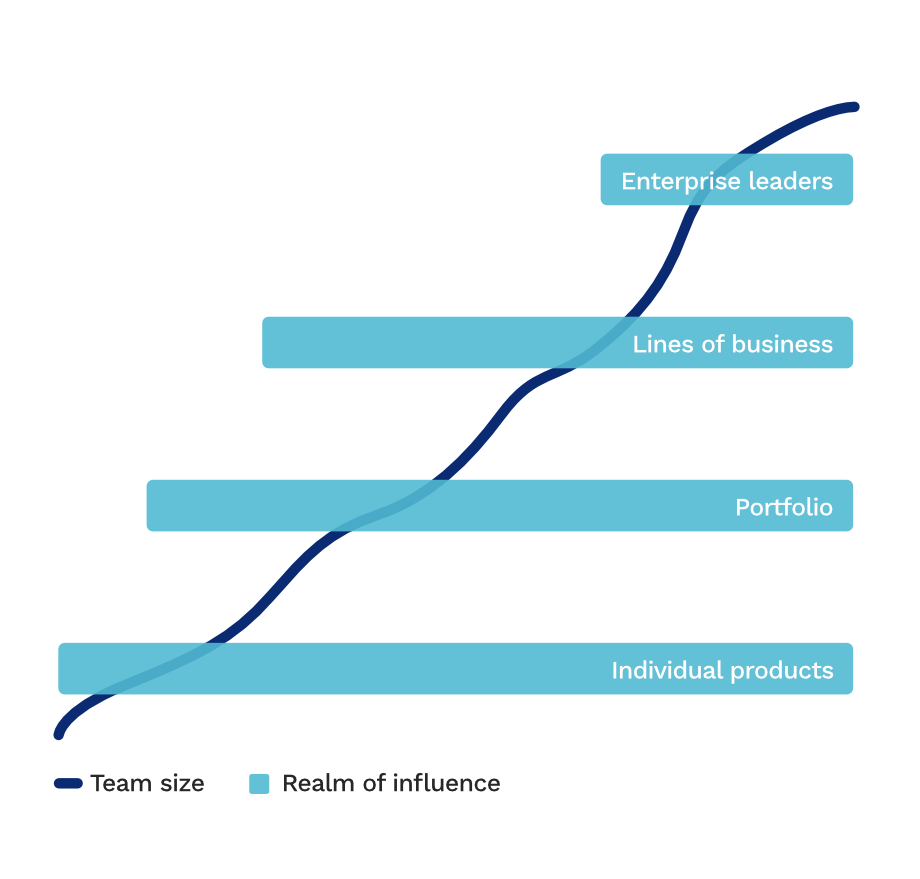
As enterprise dynamics became more fluid, our team members needed to be capable of handling increasingly more complex situations with broader capabilities of practice.
Changing environment
Our broader team's purpose was to guide and prepare teams across the enterprise for success in key initiatives, particularly around new product strategies and experiences. I managed a team of 12 designers (including 3 managers) who partnered with product strategy members of our team to run 2-9 month engagements with business and product leaders within the enterprise. These typically involved strategy or design workshops to understand the problem, then create a solution path that delivered value to the business and end users.
As our team grew and environments became more turbulent, we moved into two organizations in three years. Each move brought increasing scope to the work we needed to deliver, along with increased urgency and criticality for work to be done quicker and with fewer resources. This placed our team in a precarious position of being increasingly relied upon for things outside of our power band.
Define the goal
I began looking into all the facets that made our team unique within the enterprise.
- What kept clients coming back to us?
- What did we have that other teams didn't have the time, talent, or funds to create for themselves?
- What skills did we have spread across our entire team that we needed each individual to possess?
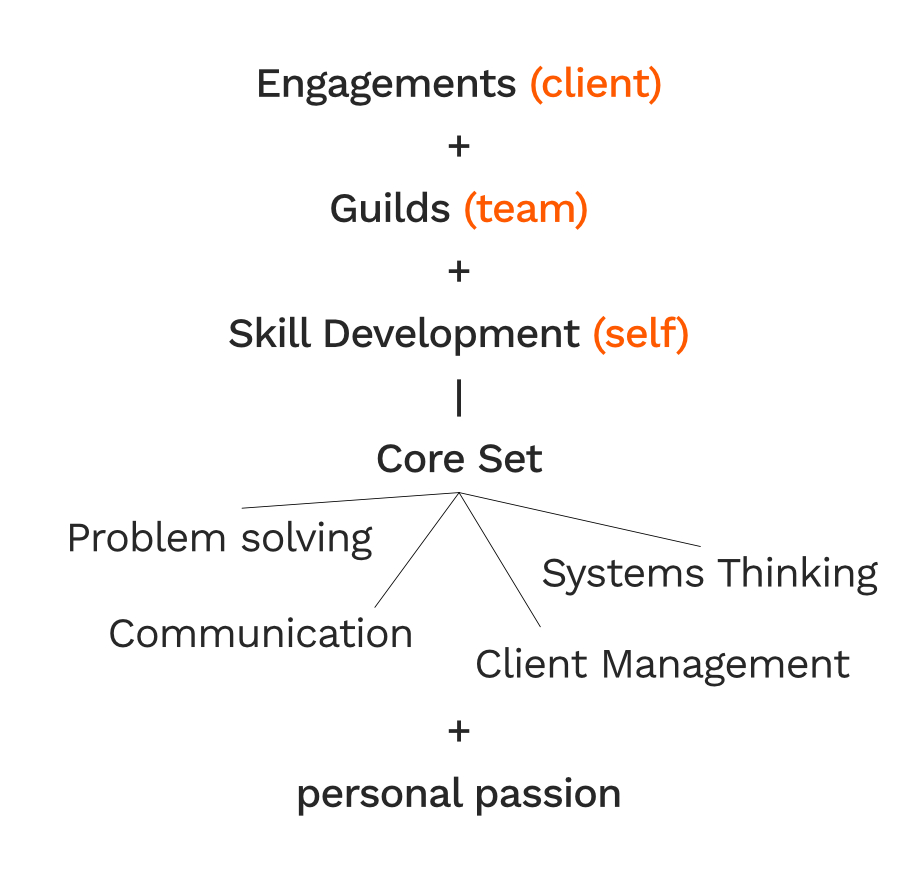
We needed the entire team capable of helping leaders solve complex problems - often problems beyond those that aligned with our training and career focus. I could present some of the skills as an expansion of existing skills, but others would be entirely new skills that every team member didn't necessarily have a desire to learn. After documenting most of the ways our broader team delivers value to clients, I came up with a list of 70+ skills that we employ. In summary, our job was changing and I needed the team to understand why and how we needed to level-up in a big way.

Humans aren't typically fond of imposed change outside of their control.
Gain alignment
Our team had a healthy culture of open dialogue and respect. I knew this was a challenge we needed to take on due to shifts within the enterprise, but that didn't mean everyone on the team understood the value in expanding our skills, nor were they onboard with taking on development for things they felt were outside of the job they were hired to do.
We already had internal team learning guilds where team members explored industry topics or practices related to our work. And they had ample opportunities to practice their skills through client engagements. The next piece was narrowing which skills everyone needed to own, and how to measure mastery.
Measure progress
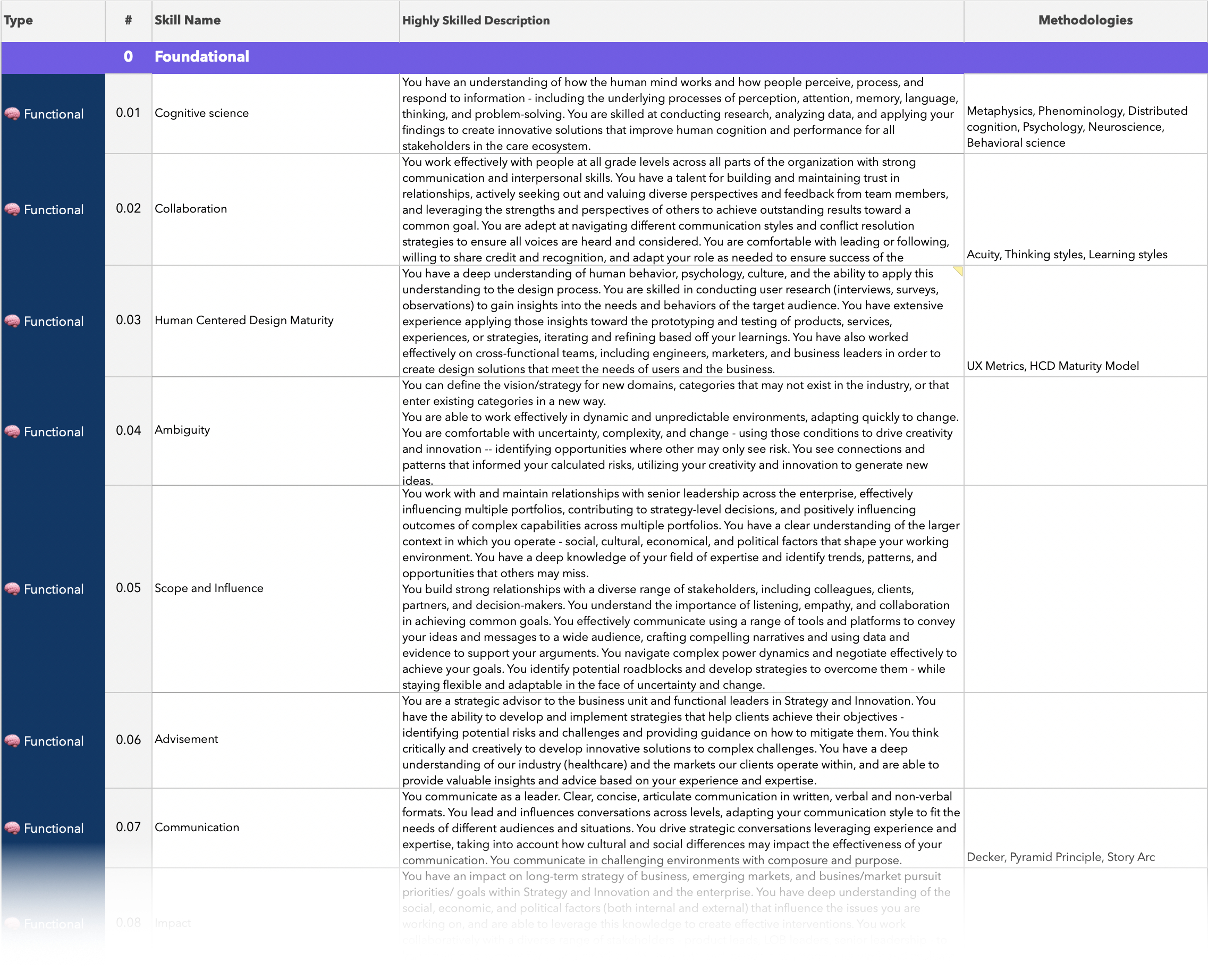
I based the system of measurement off the Stages of Competence. We didn't need everyone to be experts at everything, but we did need everyone to have a workable level of competence in the core skill set. I first defined what it looked like to be "Highly Skilled" for each of the 70+ skills. Then I defined, from a general perspective, how each level of competence could be observed.
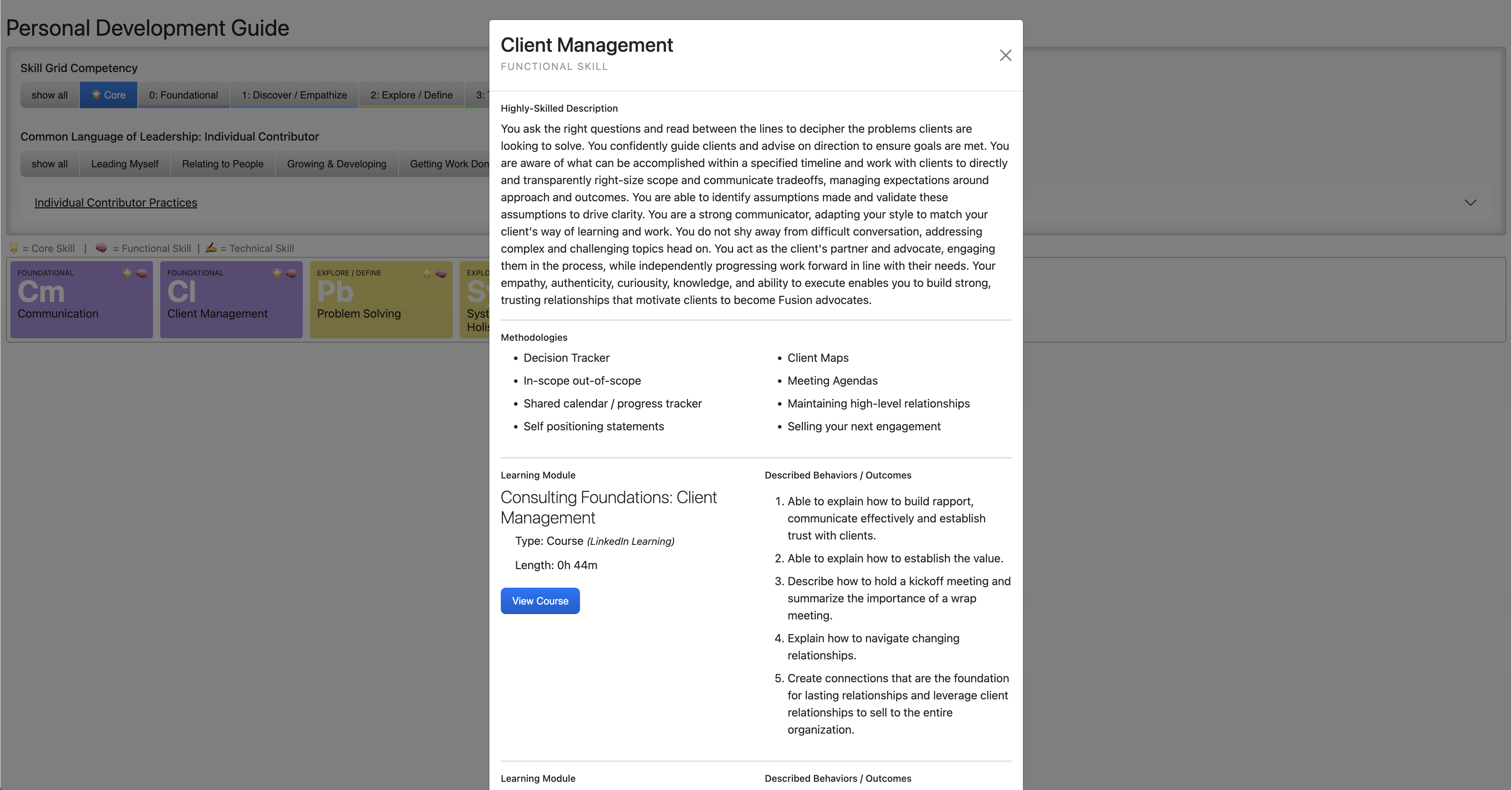
I provided the team with a spreadsheet of the complete list of skills, along with a personal evaluation worksheet to track where they felt they were in mastery of each skill. This supported conversations with managers and keeping track of progress. I also developed a website where team members could sort skills by category and link to available resources to learn and train for each skill.
Highly skilled descriptions
Competence definitions
| Highly Skilled | Highly skilled: the team member is unconsciously competent in the specific skill which is then second-nature. They can perform non-routine tasks even in unknown contexts. This stage is characterized by mastery, consistent performance and thought leadership. When appropriate, the team member leverages their expertise to benefit the entire team or the broader ecosystem outside the organization. |
Indicator: Right Intuition Need: Remain aware of experience bias |
| Skilled | Skilled: the team member is consciously competent in the specific skill. Their experience is starting to turn into expertise. This stage is characterized by autonomy, cooperation and reflexivity that translates into predictable professional performance. As a result, when paying sufficient attention, they can play a proactive and productive role within a team and accomplish routine tasks with or without an established protocol. The team member will then seek help only when truly needed and start offering help to others. This allows the team member to suggest improvements and to think critically about processes and protocols. |
Indicator: Right Analysis Need: Practice |
| Semi-skilled | Semi-skilled: the team member is consciously incompetent in the specific skill. They are aware of what the skill entails and starts to get a sense of where their ability falls short. This stage is characterized by a growing awareness of one’s capacity but unpredictable amateur performance. Still, with enough guidance and encouragement, the team member can follow a protocol and perform a routine task. |
Indicator: Wrong Analysis Need: Training |
| Unskilled | Unskilled: the team member is unconsciously incompetent in the specific skill. A lack of expertise prevents the team member from fully understanding the scope of the skill. This stage is characterized by a lack of awareness and can be observed through counterproductive behaviors. As a result, the team member needs context-specific step-by-step instructions and supervision in order to perform a routine task. |
Indicator: Wrong Intuition Need: Awareness |
Skill Grid website

A hyper-self-aware team who delivered more value per person.
Our team went through the growing pains of getting honest with ourselves and each other on what we were truly capable of and where we had opportunities to grow. It wasn't without some tough conversations, and not everyone chose to invest in their development at the same intensity. There were hard conversations of wanting skill accumulation and mastery to be tied to grade level, but measurement required observable outcomes versus personal level assessment. Some people had trouble managing the additional weight of addressing and filling skill gaps while also maintaining a high degree of work delivery.
I used Carol Dweck's Growth Mindset paired with James Anderson's Mindset Continuum to support some conversations. I also used principles from Crucial Conversations when those were more helpful. In all conversations I brought in aspects of motivational theory to have a common baseline on understanding what was driving us in our work and development.
We had some people leave the team, but those who decided to stay grew into extremely capable professionals with expanded fields of influence. Our team grew revenue by 20% through clients keeping us on projects for longer, adding work to existing engagements, or through new client acquisition as leaders heard about the level of work our team could produce. When the organization did finally decide to break up our team, everyone who wanted to was able to find new roles within the company because our clients knew the talent they were getting.